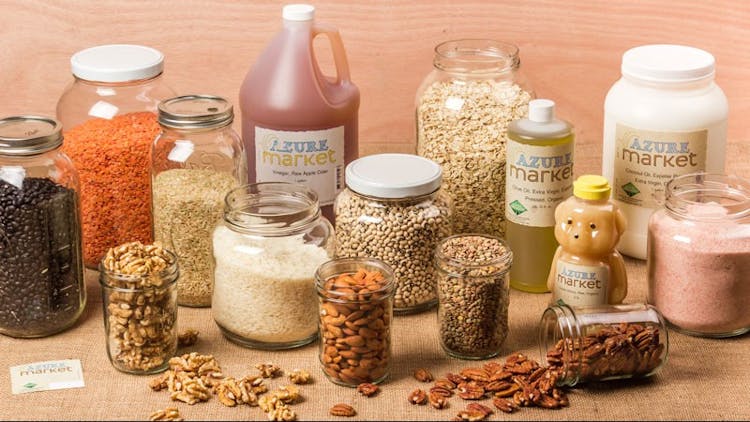
If you value healthy living, a well-stocked pantry is essential. With Azure Market bulk organic foods, having key ingredients on hand is an easy and inexpensive way to cook with real food. A well-stocked pantry doesn’t require a lot of money, special equipment, or a large space. A useful pantry can be made using materials you might have on hand and stored in a cupboard already in your kitchen.
In fact, a useful pantry is more than just a closet of shelves or a room near the kitchen; it’s what foods sit on those shelves that make a healthy home.
The Best Pantry Containers for Food
Storage containers don’t have to cost a fortune. My personal favorite containers are glass canning jars. Glass does not leach harmful chemicals and is a practical decoration in your kitchen if you don’t want to hide jars away in a cupboard. Colorful beans in glass jars make for some pretty kitchen decor. I also use large one-gallon glass jars with air-tight lids and BPA-free, food-grade plastic buckets with gamma lids.
Foods I use often, such as rice, beans and oats, are stored in buckets, and other staples, such as lentils and salt are stored in glass jars. Whatever container you choose, make sure it’s airtight. Moths and weevils are very good at getting into subpar containers and WILL get into plastic bags if you don’t repackage food when you get home. Since Azure Market bulk foods are minimally packaged, it’s easy to pour your organic foods into airtight containers.
How to Store Foods in the Pantry
It’s important to find a temperate location to store your pantry goods. According to the “Pantry Food Storage” fact sheet from Oregon Health & Science University, temperatures above 95 degrees shorten the shelf life of pantry goods, and cold garages or basements can freeze and ruin food storage. Kitchen cupboards make good storage, but don’t use cupboards over the fridge or next to ovens, as the increased temperature is bad for longevity.
I’m lucky to have a separate pantry room where I store most of my glass jars and five-gallon buckets. As long as you have an area where the temperature is not too hot or cold, it’s safe to store pantry goods just about anywhere in your house.
Azure Market Bulk Foods to Stock in Your Pantry
So now that you know where to store and how to store your pantry foods, which pantry foods are a must to have on hand? For most families, it all depends on what are the favorites, what is eaten most often or what is in the meal plan for the month. But these staples below are a must for any household because they are healthy, versatile and inexpensive.
RICE
Rice is one of the healthiest foods due to high levels of vitamins B1, D, calcium, fiber, iron, and natural antioxidants. Because it contains no gluten, rice is one of the top non-allergenic foods in the world. Rice can be served for breakfast, lunch, dinner and dessert! It’s frugal and easy to prepare ahead of time for use in soups, fried rice, rice pudding, and a number of other quick-and-easy meals. I love organic Jasmine rice which I store in five-gallon buckets with gamma lids.
LENTILS
Lentils are another nutritional powerhouse that you must stock in your pantry because they are also cheap, delicious, and easy to cook! These tasty legumes are high in fiber and iron, vitamin B1 and B6, protein, magnesium, and folate and can easily be made into soups, stews, curries, cold salads, hummus, and other spreads. They take less time to prepare than other dried beans and have many touted health benefits: increased energy, lower cholesterol, and stabilized blood sugar. I store lentils in canning jars.
OLIVE OIL
Rich in monounsaturated fatty acids, olive oil is a must for low-heat cooking and raw uses such as salad dressings. Countries with the highest consumption of olive oil are among the healthiest in the world, and studies show that regular consumption of olive oil can lead to an improved cardiovascular system and reduced inflammation. When olive oil is exposed to air, heat, and light, it oxidizes and may become rancid, so it’s best to transfer a small amount of olive oil into a smaller container and to store larger quantities in dark areas for longest shelf life.
COCONUT OIL
For high-heat cooking and baking, there is no substitute for coconut oil. It tastes great and is full of heart-healthy properties for fat loss and better brain function. Although coconut oil has had a bad reputation in the past because of saturated fat, it’s actually another healthy superfood you must stock in your pantry. Use it in place of butter in most baking recipes or fry up some chicken with it. But coconut oil’s uses aren’t just in the kitchen; it can be used throughout the house and home and even as a skin moisturizer! Coconut oil is shelf stable and does not need to be refrigerated.
APPLE CIDER VINEGAR
Apple cider vinegar (or ACV) is a must for dressings and making bone broth. It’s not as tart as other kinds of vinegar and can be used in recipes, for cleaning, and natural healing including for upset stomachs, sore throats, hiccups, and warts! ACV is also shelf stable and should be stored at room temperature.
BEANS
Another protein-rich superfood, beans have long been a staple in my pantry. Beans contain isoflavones and phytosterols that are associated with reducing the risk of cancer. They also contain soluble fiber which can help lower cholesterol levels. Beans are great in a wide variety of dishes including bowls, burritos, tacos, soups, and chili. When cooking, it is important to soak the beans beforehand or sprout them to maximize their health benefits. I store them in food-grade buckets with gamma lids.
HONEY
Honey is hands down the best sweetener and has been used medicinally for more than 2,000 years with benefits for the entire body. Honey is digested differently in the intestines than other sugars and can be used in dressings, instead of sugar, and to soothe coughs and sore throats. Honey should be stored at room temperature and can be used even after it crystallizes. Simply warm the jar of honey in hot water and stir until the crystals dissipate.
OATS
A steaming bowl of oatmeal is a very nutritious way to start the day. Full of antioxidants and a special type of fiber called beta-glucan, oats can lower cholesterol and reduce the risk of cardiovascular disease. I use oats to make delicious homemade granola and baked oatmeal. I store in five-gallon buckets with gamma lids.
NUTS
Because nuts are full of omega-3 fatty acids, fiber, vitamin E, plant sterols, and L-arginine, they are a staple in any healthy pantry. Nuts may help reduce cholesterol, keep arteries clear, and help you feel full. They’re perfect for snacking, toppings and spreads, and are also useful in baking (banana nut bread, anyone?). Nut butters and nut milk are also great to have on hand. Light and heat make nuts go rancid quicker, so store them in a cool, dark place. They can be stored in air-tight containers at room temperature for up to a month, but for longer storage, keep them in the fridge or freezer.
HIMALAYAN SALT
A good salt is a must, not only to flavor food but also for health reasons. Himalayan salt is said to be the purest salt in the world. It helps regulate the body’s water content and maintain a healthy pH balance as well. I store salt in glass canning jars.