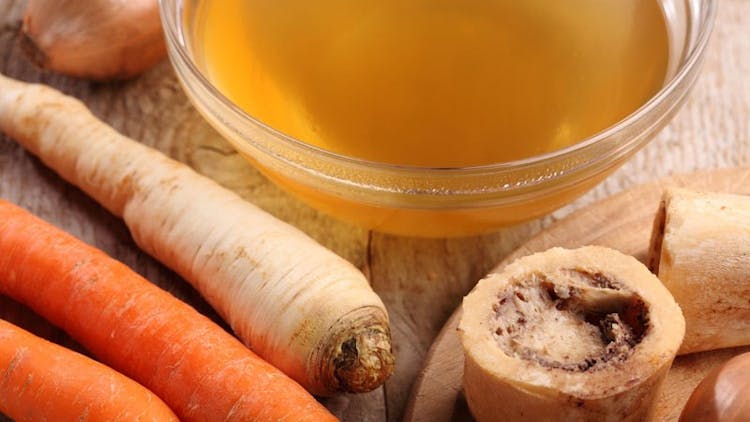
As a Nutritional Therapy Practitioner (NTP), bone broths are one of the most important foods I utilize with my clients, especially for digestive issues. Bone broths (also called bone stocks) have been used almost universally in all native cuisines around the globe and form the foundation for things such as gravies, sauces, aspics, soups and stews.
Unfortunately, most Americans have lost touch with how to make bone broths and instead rely on bouillon cubes and canned broths which are heavily watered down and use flavorings and chemicals such as MSG to mimic the flavor of real bone broths.
And because of that, they lack the true health benefits of real bone broths.
The Health Benefits of Real Bone Broths
Real homemade bone broths derive their nutritional benefits (and taste) from simmering bones for long periods in water which slowly leaches out the nutrients. This leaching of nutrients includes not only the minerals from the bones but also the nutrients that are contained in the meat, skin, bone marrow, cartilage and tendons that attach to bones.
These fibrous tissues are composed of a dense network of proteins known as collagen that also break down in a good broth and reassemble themselves into the strong but pliable tissues in our body such as our joints, skin and nails.
In fact, you may have heard of two such components of collagen, glucosamine and chondroitin sulfates, that are sold as supplements for those with joint problems.
As the collagen cooks in the broth, it breaks down into gelatin – a waxy substance that forms when broths cool (and it is non-existent in broths you find at your local supermarket). It’s the key ingredient that gives Jell-O its jelly-like consistency, and it has been prized for centuries by cultures around the world for its numerous health benefits.
In fact, the use of gelatin as a therapeutic agent goes back to the ancient Chinese. In 1682, Frenchman Papin invented the “digestor,” which consisted of a process for cooking bones or meat with steam to extract the gelatin. According to Sally Fallon Morell, gelatin back then was universally acknowledged as a most nutritious foodstuff. It acts as a protein sparer, helping to stretch a few morsels of meat into a complete meal.
The gelatin in homemade bone broth is also beneficial for the body. It helps to ease gastrointestinal discomfort, and it’s also the magic ingredient to building strong bones, assuaging sore throats and nurturing the sick.
Your grandmother (or maybe great-grandmother) almost certainly knew this and observed over and over how a homemade chicken soup made from a real chicken broth can help one recover from things such as the common cold and indigestion.
Finding Bones to Make Bone Broth
Once you get comfortable with chicken broth, you can try other simple broths too such as beef and fish. You’ll need to seek out sources for these bones as they’re not as easy to collect as a simple chicken carcass. Your local farmers are your best choice followed by your local butcher or in the case of fish, your local fishmonger. So few people value bones anymore that they’ll probably be thrilled to give them to you at a very reasonable price. Grass-fed beef bones are nutrient-dense and supremely healthy, perfect for use in broths, and Azure sells a variety of quality grass-fed beef bones including Hardgrass Beef and Azure Farm’s Piedmontese beef.
You can also build up your supply at home by saving bones in your freezer until you have enough to make a broth. And it’s perfectly acceptable to combine bones from different animals. I’ll often throw pork, chicken and beef bones together.
Making and Storing Bone Broth
I recommend using wide mouth glass mason jars for storage containers, but you could use any size or type of glass jars you want. I mostly use quart-sized ones but will often use half gallon ones when making larger batches. I don’t recommend plastic, but I will use them sometimes when I run out of glass jars. If using plastic, be sure the broth is thoroughly cooled before filling.
Bone broth will last a good week in the fridge. Anything you won't use in that time can be stored in your freezer. If you’re filling glass jars that will be stored in the freezer, always leave a few inches of headspace at the top of the jar. Broth will expand when frozen and can crack glass jars if they’re overfilled.
In time, the one larger purchase you many want to consider is a chest freezer or another type of small freezer. Trust me, once you get hooked on broths and soups, your kitchen freezer will fill up really fast. I now have a small chest freezer JUST for storing bones and broths.
Once you learn to make bone broths on a regular basis, you’ll constantly find new recipes and ways to use them. The possibilities are endless.
My personal favorite way of using broths is in broth-based soups, which are warm, soothing and oh so healthy because the soups use the broth at its upmost levels of potency. “Nourishing Broth” by Sally Fallon Morell delves into the history as well as the nutritional (and traditional) benefits of broth and is a good source for anyone wanting to learn the basics of broth-making.
Homemade bone broths, such as this homemade chicken broth, are also relevant for those looking to save money while still eating real foods, as mentioned in my book “Fearless Broths and Soups.” I may be a little biased about this resource, but it will teach you the basics of making broths and includes dozens of super simple 3-step soup recipes.
When you simmer bones in water, good things happen.
Burn that big idea into your memory and always refer to it when you’re not exactly sure what you’re doing is correct. So many people get all fired up if you don't do it this way or that way.
You say bone stock, I say bone broth. For the most part the words “stock” and “broth” are used interchangeably. Some say a bone broth is cooked for less time than a bone stock and some say the complete opposite.
Other differences in opinion include how long to simmer broths, whether or not to roast bones first and techniques for creating a gelatin-rich broth.
Listen, it doesn't matter if you can only simmer your broth for one hour, if that’s all the time you have. It doesn't matter if it doesn’t form gelatin. It's still great to use – and full of healthy nutrients. It's not a big deal if you don’t roast the bones first (though it does help with the flavor), and it certainly doesn't matter if you call it a stock or a broth. Just put what you got in a pot, simmer it for as long as you can... and good things happen.
It will be infinitely better than anything you can buy in a store.
Try These Recipes:
[whattobuybar]