It’s inevitable in this day and age that there will be trash — on the homestead, at the office, at the airport, at a public event. Trash happens, and it happens even when we aren’t thinking about it. A wrapper from a throat lozenge is nonchalantly tossed into a garbage can. An old desk that’s seen better days is taken apart and brought out to the landfill. Junk mail piles up. Food gets left on plates.
All of these are truths, yes, but at Azure, waste isn’t the end result of everything we do. Waste is reusable and recyclable. It’s energy waiting to be sourced. Waste can be redefined as something clean and sustainable. And that’s the ultimate journey.
The Sustainability Program at Azure Standard has a goal to work toward a zero-waste environment. While it is very challenging to achieve zero waste, it’s something we strive for in every part of the company — from the call center in downtown Dufur, Ore., to the warehouse in Moro, and out on the farm, orchards and greenhouses.
We have the ability to reduce, reuse, recycle, or reprocess most if not all of our goods and materials.
Azure team members adhere to the vision of David Stelzer, founder and CEO, as described in Core Value #9:
“We find that practicing ‘clean and sustainable’ is a two-way street. If you apply it inwardly, it affects outwardly; if you apply it outwardly, it affects inwardly. When we discipline ourselves to become clean and sustainable in something like our work area, pretty soon we begin noticing that other areas become more organized, too.”
As Azure’s Environmental Services Coordinator, I’m grateful to have a job I love that has an impact for the greater good through the coordinated efforts of all Azure employees. In fact, none of this would work if we were not in it together. Coordination between the different facilities and the employees is key for the success of our zero waste goals, and when we all work together, great things happen. We live our passions. We dream big dreams. We live abundantly and sustainably.
Each facility has a unique waste stream, some more diverse than others. Some facilities need a designated team member to oversee certain aspects and others run smoothly as a group effort. But the ultimate goal remains: to keep things clean and sustainable, and do more with less.
But waste is tangible and heavy, and it can pile up so fast on a farm. It can’t just disappear… or can it?
DEFINING ZERO WASTE
Zero waste, according to the Zero Waste International Alliance, means “designing and managing products and processes to systematically avoid and eliminate the volume and toxicity of waste and materials, conserve and recover all resources, and not burn or bury them.”
At Azure, however, zero waste is more than just a set of systems or policies. It’s a way of life. It’s about being organized and free from unwanted and unneeded stuff in a way that it can be maintained indefinitely without degrading. Another way to say it is in line with the definition of sustainability in that it is a capacity to endure.
The facilities that are currently on our journey toward zero waste include the warehouse, Dufur Farm and headquarters, Dufur Call Center, and the Mill. We are in the early stages of implementing a zero-waste system at the Azure General Store, Gas Station, and The Farm Stand in Hood River.
CLEAN & SUSTAINABLE
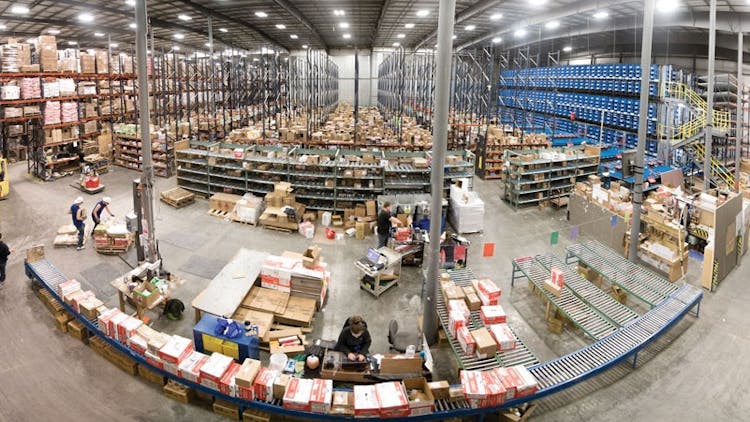
Our main recycling hubs are the Moro Warehouse and Dufur Farm. At the warehouse, we send out a truck load of recycling every week that includes the majority of various waste streams. Brian Henderson is the head recycler at the Moro Warehouse and has been a key player in making sure the outgoing recycling is organized and out the door in an efficient manner. Since Brian has started at Azure a year ago, he has kept it so organized that we have more available space for production needs!
At the Dufur Farm, we have a large container bin for metal and places for sorted building materials that can be recycled or reused on future building projects.
This is also the place for our compost where we currently have a windrow system, in which composting is done in long rows that get turned and watered regularly for proper nutrient ratios. The coolest part of the farm is the gasifier where we put our pallet scraps and wax boxes, which would normally be piles of waste. Instead, it generates heat for our year-round greenhouses.
Jeremy Candelaria has been the recycler at the Dufur Farm for the last nine months, and, oh boy, does he have his work cut out for him! The Dufur Farm includes recycling from the families that live there, the innovation team, maintenance and mechanic shop, farm equipment, Azure Husbandry and so on and so forth.
ZERO WASTE AT THE CALL CENTER
The Dufur Call Center is our most recent zero-waste facility to be up and running smoothly. Fred Kirkman oversees the recycling at the call center and gathers it up once a week for pickup and delivery to either the warehouse or farm.
But being zero waste is about more than just recycling; it’s about changing our habits, rethinking how we do things. The call center uses biodegradable kitchenware and composts any leftover kitchen scraps in the breakroom. That compost is then sent to Dufur Farm. There’s also no garbage cans at any of the desks, or anywhere at Azure in fact, but clearly labeled bins in the breakroom help employees learn where to put plastics, aluminum, glass and biodegradable materials.
It’s fun to watch employees get excited about recycling, learning about what they use and what can be reused. They bring in recycling from their households, and some have implemented composting in their home life. As David Stelzer said, what’s done outwardly affects what’s done inwardly.
THE ROAD TO SUSTAINABILITY
A walk down any hallway or a drive on any farm road is a testament to Azure’s dedication to changing the way we operate, produce, create and grow. It doesn’t take too long to see that the office desk in the corner at headquarters is made out of vintage wagon wheels, or that the light fixtures in the call center conference room are sand-blasted mason jars fixed to recycled barn wood frames.
At Azure we reduce, reuse, recycle, compost and gasify. Every day is a new lesson in waste management, a new process to rethink, another waste stream to evaluate. Being able to adapt and work with the ever-changing array of products and technologies is crucial to achieving zero waste and keeping our efforts clean and sustainable. Every day, therefore, revolves around following three clear pathways — the well-known “Three Rs.”
Reduce: “The principle of energy conservation is fundamental in how everything works, from galaxies to atoms,” states Azure’s Core Value #12. “Everything in nature does the maximum amount possible with the least amount of energy — it Does More With Less!” In other words, it doesn’t have to be a material we are reducing; it can be something as intangible as time. Hand dryers in the warehouse bathrooms replace paper towel dispensers, reducing paper towel waste. Employees are told to print on both sides of the paper, and electronic filing and invoicing are the norm to reduce paper waste.
Reuse: We are not hoarders; we are repurposers. Anything that’s used for one purpose can be used again – sometimes for a new purpose entirely. That’s the beauty of reusing; one man’s trash can be someone else’s treasure! At Azure, Himalayan burlap salt bags are reused as recycling containers. Repack boxes used for customers’ orders are purchased as seconds due to overstock or misprints. Boxes that products arrive in are reused. Packaging material such as bubble wrap and foam peanuts are stored and reused. Sometimes, we even get creative.
Recycle: If we can’t reduce it, reuse it, or donate it, we recycle it! And make some money in the process. Most materials have a market value at some point in their life. Cardboard, plastics, paper, glass, foam, rubber/vinyl, metals, batteries, electronics, fabric and textiles, construction debris and organic waste are just a few of the materials at each facility that get recycled. Hazardous material is stored safely for transport to the nearest recycling facility, and organic waste — whether it’s rotten produce or expired foods or garden debris or even scraps from someone’s lunch — is composted.
HOW COMPOST IS PROCESSED & USED
One of the most exciting projects I am looking forward to is our compost program. At the end of the day, we will have four different types of compost, all of which our greenhouses and farm can use. Maybe someday we can sell our worm castings to our customers, but until then, our composting adventures continue!
Bio-Compost into Biochar: Biochar is a fine grained, highly porous charcoal made from biological material (biomass), high in organic carbon. Biochar as a soil enhancement helps retain nutrients and water and improves the habitat — and the health — of the soil. At Azure, wood scraps, biodegradable gloves, compostable bags, plates and utensils, floor sweepings and paper towels are turned into biochar and used on the farm and orchards.
All Food Waste into Bokashi Compost: Bokashi is Japanese for “fermented organic matter.” Bokashi composting is a safe, quick and convenient way to compost using a specific group of micro-organisms to anaerobically ferment all food waste (including meat and dairy). Since the process takes place in a closed system, insects and smell are controlled, making it ideal for urban or business settings. The process is very fast, with compost usually ready to be integrated into the soil or garden in about two weeks. The call center uses a Bokashi composting system in the breakroom.
Produce into Vermiculture: Vermiculture is the process of using worms to decompose organic food waste, turning the waste into a nutrient-rich material capable of supplying necessary nutrients to help sustain plant growth. Again, it’s all about maintaining healthy soil for healthy food. Vermiculture composting includes all produce (except citrus), dry leaves and dead plant material, non-glossy shredded paper, and coffee and coffee filters. See? Coffee is more than just a pick-me-up in the morning!
Windrow Composting: Out on the Azure Farm, orchard materials, farming waste and greenhouse debris is packed into long rows or sections for composting. This allows for a larger volume of compost, and with nearly 5,000 acres of plants that need nutrients, it’s the only way to go when out on the farm!
THE JOURNEY CONTINUES
Azure is thoroughly committed to keeping things clean and sustainable. It drives us, helps us innovate and learn, and rethink the way we interact with the land. I get so excited talking about our zero-waste program and all the possibilities that I could go on and on. But the steps we take are just as exciting and fulfilling as the end result. And if we got this far, there’s no telling what else we can do.