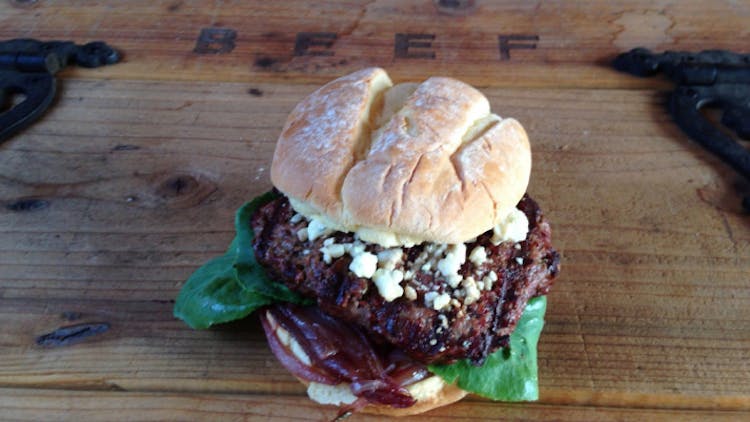
If you’re looking for beef products cultivated from beginning to end with ultimate diligence and care, and a company with exemplary standards, your search has landed you well. Hardgrass Beef goes beyond expectations and I ventured beyond their website – excellent in its own right – to get the story from the source. Purchase Hardgrass Beef
I reached Getty Pollard in his truck, working his way along a 2,000 mile round trip drive to retrieve his falcons that had been hard at work on a vineyard in California. That is about the only time you’ll find this passionate, knowledgeable man sitting “still," so I took advantage to dive in and learn more about what it is that makes Hardgrass Beef products so incredible.
"I don’t know when I started with this dream- maybe sometime in college. I had flown falcons since I was a kid, and I had a thought that I would like to raise some buffalo."
Getty grew up in Utah, and went to college in Durango, Colorado where he got a degree in Business Administration. He loved big game, rafting and kayaking, and moved to Boise for a river guiding job. It was fun and good experience, but he soon realized it wasn’t the dream he was looking for, so he went back to school to become a vet. He spent four more years doing vet school pre-requisites, got into vet school, and realized within a semester that, again, vet work wasn’t his calling. So, tired, burned-out and ready to do something else, Getty started a business doing what he truly loved, flying falcons. He began getting contracts with vineyards to provide crop protection. Starlings can be devastating to fruit crops, and falcons are very good deterrents. They fly 8-12 hours per day for a couple months a year when the fruit is coming on and ripening.
Getty began his search for land where he could train his falcons. He envisioned himself flying falcons and raising buffalo. After extensive research and thought, he opted to go with cattle instead, and chose an extremely hardy breed similar to the buffalo, Scottish Highland cattle. They are very efficient, can graze year-round, digging under the snow for forage, and they can even fend off wolves which was definitely a consideration for Getty. He knew wolves would be part of the ecosystem in northeastern Oregon, and that winters were often harsh and summers hot. He wanted to choose the best cattle breed to thrive in such an environment.
For Getty and his wife Shari, one of the most important things was to have the smallest carbon foot print per pound as possible, producing beef in a manner that is sustainable for the animals and the environment. Getty said he didn’t want to buy hay equipment and tons of fertilizer every year, and spray weeds. He didn’t want to bring in outside inputs, rather he wanted to cultivate and steward the land and the ecosystem so that it would operate in balance. They found their land outside of Lostine, Oregon, a small farming region in the Wallowa mountain range. 600 acres of their own and a nearby 1,000 on lease, the Pollards now have 250 mother cows- 700 head in total, and they have found that balance.
As for the cattle, Getty went nearly around the country, choosing his original stock from 10 different states. He said that the more he researched and learned about the breed, the more he understood just how different they are from the standard cattle breeds found in the U.S. For a little bit of history…
Some many thousands of years ago, the wild cow of northern Europe was the most prized of all in European history. It was twice as big as others, very aggressive, and the meat was exceedingly good. But, it was one of the hardest for people to actually get because they were so intelligent and aggressive. At that time, there was a land bridge between continental Europe and what is now Britain, and the animals made their way to Scotland. When the land bridge disappeared, the cattle remained. Other breeds died off in the cold, humid, windy, wet climate of the Scottish shores, but these cattle thrived.
As it turns out, the Scottish Highland cattle store their fat differently than standard breeds. They grow seasonally, and their intracellular fat concentration makes their tissue very dense and enables them to endure and even thrive through winters where they have to dig through the snow to eat. Even the butcher says it takes “more knife” to get through them.
Getty said he processes the cattle at 2 ½ to 3 years of age because when they go through multiple winters, they learn to anticipate on the 2nd and 3rd winter how to graze, and it allows them to become responsible for the development of their own fat content. When they learn that, they gain a lot of weight, tissue and intracellular fat ahead of time which they make use of in Feb-April to get through winter. On those 2nd and 3rd years, the tissue and fat reserves they put on ultimately translate to nutrients and flavor on the tongue. Getty has found that some cows are better at “figuring it out” than others, and that all of the cattle that have been born and raised solely on his land have done much better. The Pollards are doing all of this without putting up hay or feeding any grain because once a weanling calf is fed hay, it learns to wait for the hay and it doesn’t learn to go get or find its food.
The next step that definitely separates Getty’s operation from the pack is the dry-aging process he chose. Wet aging is when the butcher processes an animal and puts the cuts immediately into plastic bags where it ages in its own juices. Dry aging is taking an entire carcass and hanging it in a refrigerated atmosphere. Once it’s aged, it is carved up, put in plastic and flash frozen. This process dehydrates meat, concentrates the nutrients, and breaks down the tissues a little bit which tenderizes it. The longer it is aged, the more tenderized and concentrated it becomes. Getty said they generally dry-age their beef up to 28 days and they chose that method for one because it makes the beef better, and also because it is more sustainable. With about 15% less water weight, shipping costs are much less, and people are paying for nutrient dense meat versus water. This is a very important concept to the Pollards – the idea that you would pay based on nutrient value versus weight is something they’d like to see in general, from meat to fruits and vegetables even.
The meat you find in the supermarket is wet-aged. In essence, the money is made off of water. In Getty’s ideal world, and certainly Azure’s too, products would be sold based on nutrient and brix comparisons. He mentioned that when nitrogen is added to grow plants, more tissue is developed, but not necessarily more nutrients. This understanding is on his mind all the time- right down to the grasses and forage his cattle are eating.
“Hardgrass” is an old cowboy term referring to certain nutrient-dense natural grasses. The Hardgrass Beef farm is made up of a mixture of hard grasses, soft grasses, and other native plants some call “weeds."
Getty points out that grass roots grow in the top 2-10 inches of soil, but “weeds” like thistles, dandelions, willows and various brush types have long tap roots that take up the minerals and nutrients from much deeper. Cattle (when given the option) get a substantial percentage of their diet from eating things other than grass. Hardgrass Beef cattle graze on lands with expansive variety from irrigated to non-irrigated lands, including everything from sedges and rushes, to orchard grass and alfalfa, to native bunchgrasses, smooth brome, great basin wild-rye, sweet clover and other forbes. This rich bio-diversity translates directly into the nutrient value found in their meat.
Circling back to the falcons- part of the original impetus for this adventure- Getty has found an unexpected bonus: Large flocks of Starlings like to follow the cattle around, picking through the dung, etc. which offers him the perfect training ground for his falcons. So, while he is out checking on cattle, maybe moving some irrigation pipes, he’s also training his falcons, and, as it happens, he’s often bringing his children along to begin to learn the ropes. They’re still young yet (his son is 5 and his sweet little daughter is just 3), but already they are taking to learning, and having some fun riding around on the ATV with their dad!
Currently, the Pollards are processing about 200-250 head per year, but want to grow as fast as the market will bear. Ideally, Getty would like to focus on only processing in the fall, but it is expensive to do it that way. To best coordinate supply with demand for now, he is processing as needed during the year. This will certainly help ensure that he is able to meet the demands of Azure customers. He utilizes Stafford’s Custom Meats in Elgin, Oregon, an Artisan Butchery that takes great care to humanely process Getty’s prized cattle in a manner that adds to and accentuates the value and flavor in the final cuts.
Getty said he never knows how it all will turn out, but that you have to do what you can to change things for the better- for the coming generations and the planet. He intends to set an example, and hopes that will encourage others to do the same. For him, raising the Scottish Highlands and living the lifestyle is also about preserving history, and that is important to him as well.
He and his family have been Azure customers for years. Some time ago, his wife suggested he contact Azure to see if we might carry his beef. He shied away at first as he wasn’t quite ready. This year, she mentioned it again, so he made the call. It’s a great thing he did because Hardgrass Beef and Azure values match up perfectly, and the rich, nutrient-dense beef provides Azure customers the level of quality that exemplifies the standard of Azure. Getty said, he is very grateful to Azure for taking the risk with his small company, and that he will do everything he can to make it a success! And, just a final note, David Stelzer, Azure CEO, made a point to share that Scottish Highland was the first breed of cattle he raised as a teenager, that he was a long-standing member of the Scottish Highland Association, and that if you didn’t know… Scottish Highland is the preferred beef by the Queen of England!