A few of us here at Azure have been re-reading and discussing The Unsettling of America, a book written in the 1970s by Wendell Berry. Berry writes almost prophetically, about the shift he could see back in the 70s, away from family husbandry and agriculture, towards “agribusiness.”
This shift has become even more dramatic and has had more damaging effects than I’d imagined at the time I first read it, back in 1979! And it really all stems from a change in lifestyle and mindset; a shift in how we think about the land.
Long ago, those who worked the land weren’t called farmers; they were called husbandmen. Consider the word “husbandman” and its relation to a husband. A husband’s duty and purpose is to care for and nurture his wife and family. He protects them and looks after their well-being and health. He makes a lifetime commitment to the woman who becomes his wife, and to his family for generations to come. Notably, he functions with the best interests of his family in mind.
Likewise, when the term “husbandman” was in use, it referred to a caretaker who makes a commitment to nurture the land for a lifetime and beyond. A true husbandman would have thought about the land all the time, been connected to it, and would have done what was best for the land, even sometimes to his own detriment. The husbandman would know the land, and his footsteps would have been imprinted all across it. He would’ve recognized that his own well-being was tied up in the land, and he would tend it with respect.
I am sure we can all agree that most farmland today is not tended under this husbandman ethic. Instead, we see that agribusiness has replaced it. Under an agribusiness approach, the land is a resource to be mined…how much product can be extracted from the land at the best profit? Considerations for “care” are only considered inasmuch as they impact the bottom line, and in agribusiness, farm decisions are made in a boardroom (often far from the land) by someone who has likely never set foot on the farm. The workers are most frequently hourly employees who follow the board's instructions. When land is managed as an agribusiness, the farmer’s pay is directly dependent on the number of tons of product he brings in. In this way, his actions are short-term and business-driven, more so than informed by a land ethic.
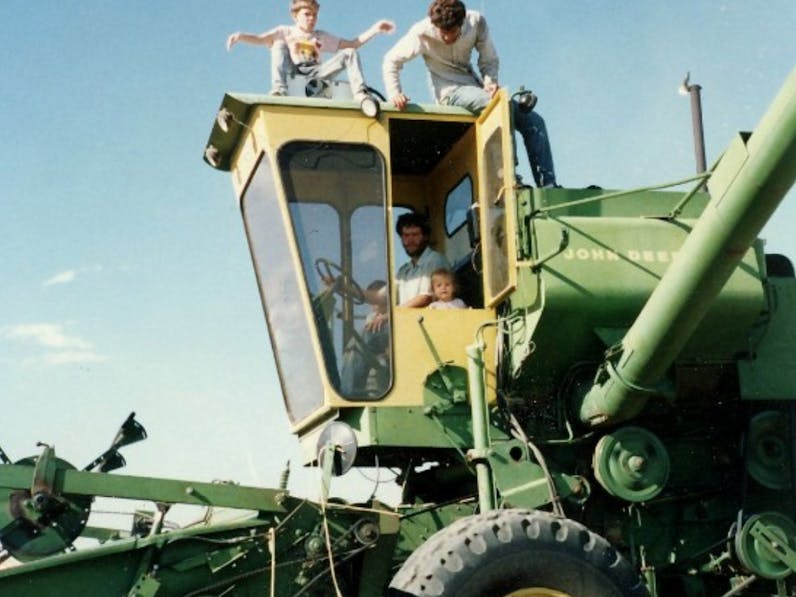
Yes, a farm has to be an economic entity if you’re making a living at it. But for many of us, the land is more than that—it is a connection that runs deep into our souls and brings meaning to our lives. The work brings deep satisfaction, and the connection is profound.
In the Book of Genesis, we read that Adam was created to cultivate the land. I started to think about that word, “cultivate.” “Culture” comes from the same root as cultivate, meaning to tend. Culture encompasses the people, including farmers and their families.
And “agri” of course means land or field. Do we want to have a field business (agri-business) or a field culture (agri-culture)? Seems to me that an agribusiness is not a culture, and the people are an afterthought. The health of the land is also an afterthought. The business and the product are the focus. It’s plain to see this isn’t good in the longhaul.
Where am I going with all this? Well, I see a real drive back to agriculture, with a husbandry ethic. It is good to see people working at returning to a life of tending and caring for the land, and restoring it. It’s got its challenges, because most of the “good” fertile land is unaffordable, since large-scale agribusiness has swallowed up much of it. What’s left is third-rate land that has been abused, and requires restoration.
But as I visit homesteading conferences, I see people who are feeling compelled to move back to the land or to forge a connection. Whether or not they grew up with a background in farming, they understand the need and are answering the call. We need more of these homesteaders who are willing to tend and care for the land as husbandmen. We don’t need more agribusinesses looking to mine the fields. As Joel Salatin describes in his book, Homestead Tsunami, we are witnessing this movement.
My dad, Alfred Stelzer, really embraced the role of husbandman to our land. He wrote a song about our land, and here are a few lines that I have memorized and love to replay when I’m out on our farm:
“Hear the word of your God, you fields of Jacob
You’ve been burdened by greed and strife
But today I’m giving you life
Now you’re serving redeemed man
So yield the fruit of your strength to the sons of Jacob
Hear the word of your God, for now my fields shall live.”
I think this distinction between husbandry and agribusiness reflects a truth common to many aspects of our lives. When it comes to our families, we can choose to “mine” them, looking at what we can extract, in a business-like manner. Or, we can nurture them, building a healthy culture of caring for one another. We can’t maintain healthy relationships if we are looking for what we “get” from people. That’s no way to live a meaningful life, nor is it the way to create a positive difference in the world. But when we cultivate and nurture our family, marital, and work relationships, that’s where we can change the world and our lives for the better.
We are built for this. Relationships—with land and our fellow man—are meant to be tended. Let’s apply the husbandman concept to everything we do in our lives.
In Gratitude,
David Stelzer, Founder and CEO of Azure