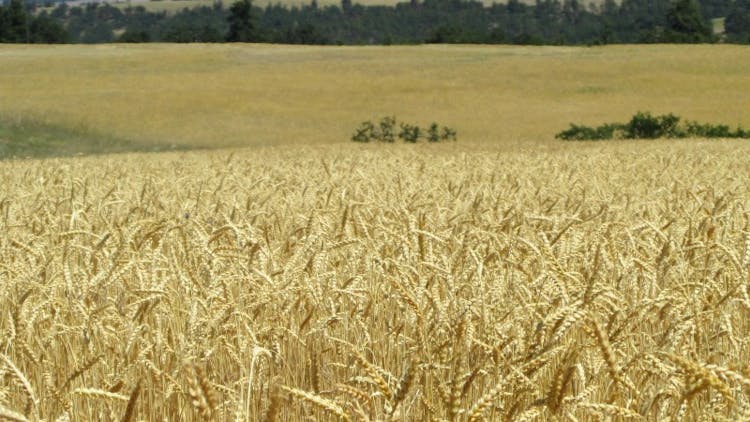
I have wheat on my mind.
I’m not a wheat farmer. I’m not gluten intolerant. Aside from my brilliant piece of fresh sourdough toast in the morning (thank you Blue Skies Bakery FG586!!), I don’t even eat that much of it anymore. But, I think about it a lot. For one thing, Azure largely got its start in the market place from bountiful grains of wheat, and continues to grow and sell its many incarnations (grains, flour, mixes, etc.). Of course, Azure customers frequently ask about Azure’s wheat. Moreover, my mother discovered after many years of battling unknown skin maladies that she has a pronounced gluten allergy. Then, there is the modification of wheat (naturally or genetically) and the way in which it is grown that have altered wheat and maybe the way it interacts with our bodies. Plus, need I say that wheat is one of David Stelzer’s favorite topics? He is hugely knowledgeable on the subject and it’s a hoot to get him talking about it (which I did for this article!). So, wheat is on my mind, and clearly on the minds of many of you. Let’s talk about it… wheat’s history, its botany, its performance, and we’d be remiss without some super recipe ideas, too!
Wheat is one of the oldest cultivated cereals in history. Do you know which variety was first? Trick question, really – not sure if the exact answer is known! But, two of the oldest are Einkorn and Emmer – the known domestication of which dates back to the mid-8000’s BC in the Fertile Crescent. Part of David’s interest and fascination with wheat stems somewhat from his belief that wheat civilized the world - enabling people to settle in villages by not having to continuously “chase after animals.”
Wild wheat has a very brittle cob – the kernels readily separate and fall off, even in a strong wind. It’s figured that in a sense, circumstantial “selective breeding” was performed at the onset of wheat agriculture, as only those with kernels that held onto the cob long enough to be transported and planted were actually cultivated. Over the millennia, endless amounts of selective breeding and hybridization have been done in the quest to make better and different wheat, so it is important to know the differences between selective breeding, hybridization, and of course our most recent endeavor – genetic modification.
In selective breeding, you are selecting for desired traits within the same variety. Say you want to improve cob strength- you choose samples of the same variety that show less fragility in the cob, and breed those samples together.
Hybridization is when you cross different varietals to create a new one with desired attributes of the two. As an example, the origins of spelt which is an ancient variety in itself, comes as the cross between emmer and either “goatgrass” or bread wheat (cultivated variety). As for genetic modification, man artificially inserts genes of another variety or species. This is done using gene guns, super virulent bacteria, and viruses which inject and hold the foreign genes in place. The classic example of that is the insertion of fish genes into strawberries to reduce the strawberries’ susceptibility to rot. Genetic modification is also now standardly used to inject biopesticides like Bacillus thuringensis toxin (Bt toxin) directly into the plant.
The purpose is so that instead spraying (or to reduce spraying), the insects will simply die when they eat the plant because every cell of the plant is laced with the pesticide. That said, GMO wheat has never been legalized. The Wheat Association is staunchly opposed to genetically engineered wheat because wheat is a major export commodity for the United States, and they know that our foreign markets would be terribly compromised. Indeed, we have seen that with the recent scandalous find of unauthorized GMO wheat in an Eastern Oregon farmer’s field (results still TBD). So, those are the 3 basic ways of changing and developing varieties. While we could easily go on and on about the horrors of genetic engineering, I do want to focus more time on hybridization – the creation of new varieties, because it is relevant for most of the wheat we are likely to eat
When a new variety is being created, it takes a certain (unset) number of generations to become “true to type”, i.e. for the new variety characteristics to “fix” and not throw back to either side. I say that so you understand when I say that Azure only buys true to type varieties when purchasing wheat- we never buy “F1” ( first generation). That is important because when a variety becomes true to type, it becomes consistent, and Azure is very particular about characteristics of wheat. Azure mostly grows and saves seeds, but when seed purchases are necessary, it is only true to type seeds that are bought. Also, just a quick note on breeding- whether selective or hybridizing: Wheat is self-pollinating. Its stamen is right there above its flower so there is a very short distance for the pollen to travel. It makes selective breeding and hybridizing challenging and an art almost. It can happen in the wild, but it is not common.
So, what about the characteristics of wheat? First, what is it we do with it? We bake with it and we make it into pasta - those are its two overarching uses (clearly there are more, but those are primary). Basically, the whole purpose of breeding and hybridizing is to produce a better loaf of bread or bowl of pasta… Amazing to consider the lengths to which we go simply for a good sandwich! Three of wheat’s fundamentally important characteristics are the moisture and protein content, and the falling numbers which are used in the baking industry to describe how well it rises. Here, we’ll focus mostly on moisture and protein.
Understanding the type of wheat goes a long way in telling you how it is going to perform and what it is going to taste like.
The moisture content of wheat is critical for its storability, and has to do with what the weather does at and just before harvest. Rain or storms at that time can wreak havoc with moisture in the grain. The best range is between 8-11 percent. If it is above 11.5 to 12 percent, it does not store well and becomes musty. It is not as big of a deal if it is below 8 percent, but it might need a little moisture added to grind properly. Azure ensures that the wheat is tested, and only sells wheat that is in the optimal range. As for storing wheat, know that if it is stored properly, it can last a very long time. It is hard to get an exact number of years – I’ve heard everything from 30 years maximum to a “lifetime.” But, for it to be viable and worthy of eating for any length of time, you have to do these three things: 1) Keep insects out, 2) keep it dry, and 3) keep it cool.
Understanding the type of wheat goes a long way in telling you how it is going to perform and what it is going to taste like. “Hard” wheat is higher in protein, and “soft” wheat is lower. The color attached to hard or soft largely has to do with the intensity of color and taste that will be present in the final product- it doesn’t indicate a significant nutritional difference. Also, “winter” versus “spring” wheat really only indicates what time of the year the wheat was planted; it does not necessarily reflect a nutritional difference either. But, for those of you who grow and eat your own wheat grass, there might be a slight difference in the wheat grass yields between winter and spring wheat. This is not hard and fast science, but in the Stelzer family, they notice that winter wheat can yield up to 3 lighter cuttings of wheat grass, while spring wheat yields a much larger first cutting but not much after that.
As for protein- bear in mind that protein and gluten in wheat are “twins” (their levels mirror each other), qualityhard red and white wheat fall in the range of 12-16 percent protein. That’s why the hard varieties are the best for bread making because protein is what gives bread its stretchiness. It is not very common to get 16 percent protein levels on the retail market though because wheat with that much protein is often mixed in with others that are coming in lower. For example, you can mix (not in equal portions) some 16 percent with some 11 percent and come out with an overall protein content of 12-12.5 which is excellent for baking. Azure’s wheat is guaranteed to be at least 11.5 percent protein. Hard red and white don’t really differ in protein; their difference is noticed in the color of the final product and the intensity of the “nuttiness.” Also, the whites tend to rise better.
Soft whites (and reds) have lower protein levels, usually around 8-9 percent. They provide for light, potentially airy texture - perfect for cakes, pastries, muffins, pancakes, etc. Soft whites are the most popular, and Azure grows a few different varieties (not sold separately). Two of David’s favorites for taste and performance are Stephen’s and Club. Both are cultivated varieties – Stephens was developed in the 70’s, and Club is one of the most common soft whites grown in the Pacific Northwest. On a side note, soft reds are not grown in this region much at all. They are grown extensively in the moist south like east Texas and Kansas, Missouri, etc., and are a primary export for pastries overseas. Soft whites don’t like moist summers, that’s why they love Wasco and Sherman Counties in Oregon!
Continuing in the protein vein, and making use of our knowledge of hybridizing, we need to discuss modern wheat. Is there truly a problem with the modern wheat varieties themselves, or is modern, conventional farming practice more the culprit? Meaning, there seems to have been a substantial increase in gluten intolerance and obesity – is that due to the new varieties of wheat or the means by which they are grown commercially? Over the last decades, wheat breeders have created varieties that are shorter and stockier on purpose so that they could be pumped with more and more nitrogen (think chemical fertilizers). Nitrogen creates the growth- and at the rate of modern day nitrogen application, the heritage varieties simply couldn’t handle the amount; they would tip over (lodge) on their more spindly stalks. However, even though the overall increase in growth is evident in the plant, the proteins are not being created in complete chains – only the amino acids that are able to handle that amount of nitrogen are there, not the rest. So, yes, more protein and gluten, but they are not complete. It seems fair to at least pose the question- where does the trouble lie? Is it wheat itself, or are our bodies reacting to the lack of wholeness in our whole grains that are conventionally grown? Certainly there needs to be study on the matter, and it will probably be some time before we get to the bottom of it.
To wrap up, I want to give you some thoughts on recipes. These come from my probing of Evagene Stelzer – matriarch to the Azure family of Stelzers -- for her best thoughts on wheat and combinations…
Have fun with your recipe experiments!
- Use ½ hard white and ½ hard red for bread making. The hard white makes it rise nicely, and the hard red gives it the best flavor.
- Spelt rises nicely also- add a little hard white to it to increase its protein/gluten.
- Try a little Kamut mixed in for its flavor, but add the hard white to help it rise.
- For fun with waffles and pancakes, try soft white wheat with some milo (sorghum) for added flavor.
- If you have unexpected company, and don’t have enough starter prepared, use yogurt and soda for lift– be sure to add egg as well.
Finally, let me leave you with a tale…
In 1980, David Stelzer, founder and CEO of Azure, took his first solo trip across the country. He heard about a farmer practicing old-time farming methods, so he gassed up the truck and headed over the mountains and across the plains of Kansas. A week later, he arrived back home with seven bags of wheat – 3 Turkey Red, 2 Wichita Red, and 2 Heritage Soft White that originated in middle Europe long before. Those bags of grain were truly part of the foundation on which Azure was built and has grown to this day. Some of the wheat that grows in the fields of Azure Farm today directly descends from those original seven bags.