My heart rate was only 45 beats per minute -- way too low. The nurse put out a call and the room suddenly filled with doctors and nurses. I stared at the pulse/oximeter monitor on my finger. The pulse was definitely low, but the oxygen saturation was still good. Since becoming very sick with neuroendocrine carcinoma a few months before, my pulse was typically between 90 and 105. So, this was about half its usual rate. (Read more about my 2021 cancer journey in the previous articles of this series.) The pulse didn’t budge. “We can’t give you your apheresis treatment today with a pulse like that,” I was told. “Just rest here and we’ll arrange for an EKG and see what we can find out.”
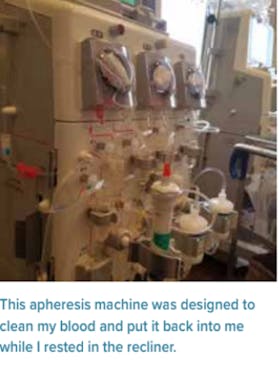
In an apheresis treatment, a special machine filters the blood to remove undesirable things and is then circulated back into the body. All one really has to do is sit there and relax. Many of the patients getting treatment at Envita Medical Center told me they felt better and had more energy after their own apheresis treatments. I felt especially privileged to get this helpful therapy and had been looking forward to it.
I texted Gloria (my caregiver at that time), to tell her the disturbing news. She had dropped me off at Envita not long before expecting I’d be in apheresis treatment for several hours. But, with the news of my low pulse, she sped back to the clinic. The doctors had just left the room when she came in. She took one look at the fingertip pulse monitor, knelt down by my knee and said, “Let’s pray!”
As soon as she had finished praying, the pulse rate started going up -- and quickly! As we watched, the pulse monitor showed the pulse rising by 5 or more beats at a time and settled in at about 90 beats per minute. Whew! What an amazing answer to prayer! We were both astounded and thankful. The nurses were amazed too!
To the Hospital for Observation
But, to have such a serious thing to happen just before starting an apheresis treatment was concerning to the folks at Envita.
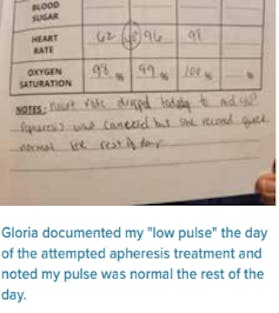
When my heart rate was a bit erratic the next day, they encouraged me to go to the emergency room to get checked out further. Although they felt that it was highly unlikely that the low-dose chemo drugs they had given me would have caused any heart problems, one of those drugs, Doxorubicin, is known to cause heart damage. I had received that drug three times (at a dose about 1/10th of conventional chemo levels) at one week intervals prior to this. So, it was important to see what might be wrong.
I spent that weekend of May 1st, 2021, under observation at a small hospital in Scottsdale, Arizona. I had an echocardiogram done, and during the entire stay I had no heart-rhythm abnormalities at all -- not even when Gloria inadvertently gave me a cold shower while I was there! Although she had helped me take a nice warm shower (something of a luxury for me at that time), she accidentally showered me with freezing cold water while trying to turn off the water! I figured if I was going to have a heart attack, that would have given it to me! It didn’t, and instead I spent time walking the halls of the hospital to try to not lose any more muscle. I had no heart rhythm issues while there and felt fine.
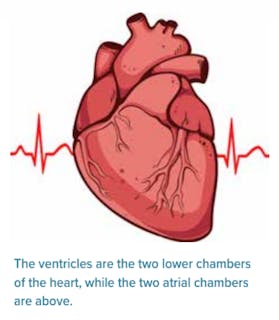
However, the cardiologist informed me that my ejection fraction (EF) had dropped to 35% from its previously healthy 60%. (Normal EF is 50-70% and 40% or less means the left ventricular muscle is weakened and indicates heart failure.) Something had happened. I was prescribed a beta-blocker. The ER doctor had also explained the low pulse. He said it wasn’t actually a low pulse, but just that the electrical impulses were not being read the same by the different monitors. Once I learned this, I was able to recognize the situation by taking my own pulse manually. One strong pulse, then a weak one… the pulse meters were only picking up the strong beats, not the weak ones and this gave the illusion that my heart rate was exactly half of what it should be. What an amazing revelation. I would learn that these odd-rhythm beats were called “bigeminies.” I had “PVCs” (Premature Ventricular Contractions) as well.
Not the First Time for “Low” Heart Rate
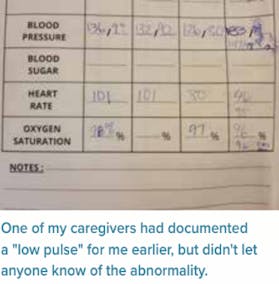
Looking back through my home health notebook (where my caregivers kept track of my body temperature, blood pressure, heart rate, and blood oxygen saturation) I now see that one of my caregivers had recorded a low pulse of 46 the previous week. But they didn’t mention the odd-ball low pulse to me or my doctors. So, the episode at Envita had been a complete surprise.
However, as I was getting up from the recliner, I nearly fainted. The nurses got me to a wheelchair and I nearly fainted again. But, it soon passed. I thought everything was going to be okay. Uh… nope.
TPN: Nutrition through an IV
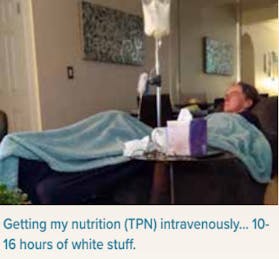
Since late February 2021, when I started cancer treatment at Envita, I had been receiving my nutrition by IV.
Called TPN (Total Parenteral Nutrition), it is a bag of white fluid that is given by IV overnight - every night. My blood test results were shared weekly with the makers of the TPN and the formula was adjusted according to my needs. It replaced food completely for me because I simply couldn’t keep down the food I ate by mouth. I would try to eat easy-to-digest soft foods, but more often than not during those early months of my treatment, it would give me a horrible stomachache and I would throw it all up several hours later. Having TPN nutrition made it so that, despite not eating anything, I wasn’t hungry and still had enough nutrition for energy and healing. It truly was a life-saving thing for me, but it is certainly not complete and healthy nutrition!
About the time of these heart rhythm problems, Karen (a previous caregiver) was still monitoring my situation and had been in touch with my TPN provider about my heart issues. They saw the bloodwork and would be sending a new TPN formulation to help. My current caregiver was to start giving me the new smaller bags that weekend along with a new pump that was programmed to infuse the lower volume over the same amount of time (resulting in a slower drip). I don’t know exactly what transpired, but I do know that the pump was never used. It was found later, still in it’s bubble-wrap. All I can assume is that the new formulation with lower volume was infused into me using the old pump. Not good.
The Big Cardiac Event
On Friday night I felt disturbed and distressed over recent events and was just glad to get some sleep. But, around 4:00 am I woke up with what I thought was a terrible case of PVCs and Bigeminies. With both my night-time and day-time caregivers there, they encouraged me and prayed with me, and I did everything I could to calm my heart with peaceful thoughts. But, the attacks came in waves. It was a feeling I’d never experienced before and still can’t quite describe. I felt like I couldn’t breathe, yet I could easily take a big breath of air. At one point I made what I thought was a strange request of the night-time caregiver, asking him to push down hard on my head. Oddly, that seemed to provide comfort. It felt like I was having the world’s worst anxiety attack, but at the same time I felt completely at peace. It was weird -- not painful as such, but more like the pain of grief. I was scared, but kept pushing through, hoping the next wave wouldn’t come. But, it always did.
I wasn’t aware of the passage of time during that ordeal, but soon the room was filled with what seemed like a dozen paramedics. I learned later that my day-time caregiver had called 911 around 6:45 am when she could no longer feel my pulse and the night-time caregiver was planning to leave at 7:00 am regardless.
The paramedics picked me up out of the recliner easily and put me on the gurney waiting just outside the apartment door. They loaded me into the waiting ambulance and I remember the driver commenting that he was going to wait to turn on the siren until after we left the gated community. I heard the siren and figured we were on our way. The paramedic in the back with me looked at me with intense blue eyes over his mask. “Another wave is coming!” I told him. He looked at the monitors and sure enough, my claim was verified. “You’ve got to breathe!” he demanded. I got a little distracted as the wave got worse and he hollered at me, “Breathe! BREATHE!” I saw the pleading in his eyes and realized that the only thing I had to do in this whole world at that moment was focus on breathing. Breathe, Susan, breathe!
In the Emergency Room
The ride in the ambulance was short as the hospital was only minutes away. Soon I was in the Emergency Room with another dozen people swarming my bed and sticking “stickers” all over my chest -- big stickers. They asked me questions, stuck me with needles, got IVs dripping. And soon I felt better and most of the people gradually left the room. I had been given the drug “Amiodarone” -- a very dangerous drug, but one that can also save your life. It worked to stabilize me and they didn’t have to shock my heart.
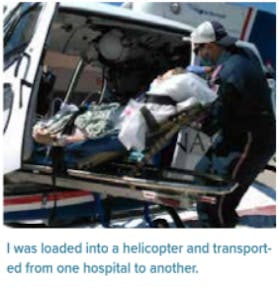
My day-time caregiver arrived and sat with me in the ER. I was told there were not enough ICU beds available in this hospital so I would be transported to another hospital by helicopter. Wow! By this time I was feeling so much better I started joking with the flight medics. “I don’t see your parachutes,” I kidded. I then enjoyed a beautiful ride over Phoenix. It really is greener than you might think a desert city would be. By the grace of my Heavenly Father, I had survived a Ventricular Tachycardia (VT) attack.
My ejection fraction had dropped to a mere 25%. After all the trauma had subsided, I was exhausted and thought to myself, “If that’s what it's like to die, I don’t want to do that again!”
Needing a Prognosis I Didn’t Have
A lady in a colorfully-patterned flowing dress looked at me over her clip-board as I sat on the edge of my bed in the cardiac intensive care unit a few days after my ambulance (and helicopter) ride. She looked at me intently and I wasn’t sure whether she was sincerely curious how I would answer, or pained at having to ask me these questions.
She had been to visit me once before and had shown me a picture of what my heart rhythm looked like when I had arrived at the ER in the ambulance. At 250 beats per minute it looked more like a seismograph measuring an earthquake than a heart rhythm. To help me understand the gravity of the situation, she had pointed out that most people don’t survive this high of a pulse for as long as I did. She explained that most people with Ventricular Tachycardia (VT) attacks have hearts that are weakened (typically in older folks), or diseased, and therefore most people die from it. But, here I sat -- a survivor.
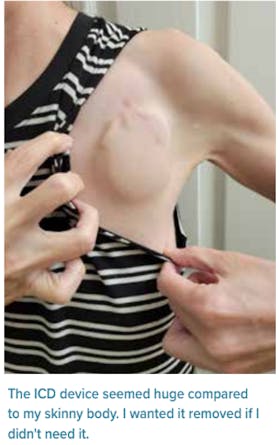
I understood she was here to determine whether I would or would not be getting a potentially life-saving ICD (“Implantable Cardioverter Defibrillator”), a defibrillator/pacemaker combo. Although my heart had been completely stabilized, I now understood that I would not be allowed to leave the hospital without a device to help me survive the next expected VT attack.
A Catch-22
The problem was that a policy exists somewhere that if you are expected to die of cancer within a year, an ICD will not be installed to assist your heart.
I guess that makes sense since you don’t want to fix up someone who’s just going to die soon anyway, right? But, it was clearly a catch-22 from my perspective. I couldn’t leave without a device, yet I couldn’t get an ICD installed unless my cancer prognosis was greater than one year. The kicker? I had never been given a prognosis.
No, to this day I’ve never been told what “stage” of cancer I was in at any given time. (2023 Update: See Envita Case Study.) I was not told how long I had to live. No prognosis existed for me. My doctors at Envita were asked to provide a prognosis for me so that it could be determined whether I should get the ICD or not. Their response? They would not give a prognosis for my survival because only God knows my future and His plans for me.
Making the Case for My Life
So, here I sat talking to the woman who had apparently been sent to determine whether I would get the ICD or not… to determine my future. She began asking personal questions about my life, my goals, my ambitions, what I found important in life. I suddenly realized that I was in an interview to determine whether I deserved to continue to live on this planet. Would I be an asset to society and the world? Did I have the will to live and do good? As this realization dawned on me, I began sharing my vision and passion for helping others. I shared with her all the people that depend on me and the good work that God has asked me to do in His service. I poured out my best case for being given the opportunity to get the help I needed so I could continue to work toward beating the cancer and continuing to live a productive life.
After I exhausted my efforts to convince her that I was worthy of being helped, she shuffled her papers and said, “Well, since I wasn’t able to get a prognosis from your doctors at Envita, I did some of my own research on your particular kind of cancer and found that it appears you have a 51% chance of living 1 year past your diagnosis date. That’s good enough to fulfill the requirements to be able to get the ICD despite your cancer.” And that was that. The ICD was installed the next day.
In hindsight, I’m very thankful that none of my doctors along the way told me what my chances of surviving my kind of cancer might be. I’m glad no one told me the odds. I’m glad no one told me how long other people with my kind of cancer live. I am unique. My life is in my Heavenly Father’s hands and He knows the path that I take. Job 23:10 says, “But He knoweth the way that I take: when He hath tried me, I shall come forth as gold.”
After the ICD
After I had been discharged from the hospital with the ICD installed and multiple heart medications, I once again had trouble with heart pounding sensations, and “low pulse” readings that indicated PVCs and Bigeminies. How could this be?
My brother, Jim, arrived to be my day-time caregiver a week after the ICD was installed. The first day he was with me I had an appointment to have my ICD checked. It showed I was continuing to have brief instances of VT and I was sent back to the hospital for observation. The first day they didn’t give me any TPN and I was hungry, so I ate some hospital food. I started feeling better, walked the halls multiple times, and was eventually hooked up to hospital-provided TPN again. No heart issues were recorded. None.
When I was discharged, I had a big appetite and plenty of energy so ate a big supper at home and went for a nice walk. No cardiac issues!
That night, Jim noticed that my TPN pump was set up wrong. It was set up for a larger bag than the one I was provided. This would result in a faster rate and no taper off phase. Since that’s the way it had been running and he didn’t know how to reprogram it (and hadn’t yet discovered the new properly-programmed pump still in it’s bubble-wrap) he ran it anyway. The very next day I was sick with PVCs and Bigeminies again! (The ICD wasn’t designed to help with those things).
Jim made the connection: every time I went in the hospital and got on their TPN formula and pumps, I got better. Every time I came home I got worse. So, we decided to quit the TPN cold turkey. I had already started successfully eating crackers with butter or peanut butter and had eaten a good amount of hospital food, so why not try to start eating completely on my own without using TPN? After all, it seemed that the tumor embolization procedure might have already helped shrink my tumor, and I was no longer as nauseated as before. No home-TPN that night. The next day I felt much better, had a hearty appetite, and we knew we’d found the answer, but my heart still needed to heal and get stronger.
We followed up with the electrocardiologist who managed my ICD and he agreed that an electrolyte imbalance was highly likely and had also suggested I begin reducing some of the heart medications because they have long-term seriously bad side effects. I really wanted to be off of all drugs for sure.
My acupuncturist, Robert Koagedal (of AcuHealth in Scottsdale), had introduced my brother to a book titled, “The Uncharted Body,” by Dr. Daniel Keown. The book brings together the medicine of both the Western and Eastern perspectives, and it had a section all about the heart and its electrical qualities. Jim was able to put together this information with his own knowledge of electric motors and had an “ah-ha moment” about the electrolytes. But, Robert said that since I was on beta-blockers (which change the electrical pattern of the heart), I would need to be off of those medications before acupuncture could really help the heart start functioning in its normal electrical pathways. So, I really wanted to be off the drugs so my heart could truly heal.
The Loony Cardiologist
“I care about you very much,” the cardiologist crooned, as I sat in his exam room with my brother, a month after my VT attack. “I was with you at your worst, and I don’t want you to go through that again.”
The memory of it all was very fresh in my mind. This cardiologist must have been one of the dozen doctors and nurses that swarmed the gurney when I arrived by ambulance at the ER. To see me then would have indeed been to see me at my “worst”. He now began to explain what tests and procedures needed to be done for my long-term care. “But, I’m feeling better,” I began to explain.
More Meds?
“Yes, you’re feeling better because you had an ICD installed and you’re on all the heart medications. This one medication in particular I want you to start taking 4 times as much. Now we need to find out what caused your VT so it doesn’t happen again. Maybe your arteries are blocked, maybe we need to do a heart ablation.”
“But, I’m feeling better, and we’ve found the cause of the problem, so I’d really like to get off the drugs as soon as possible,” I began. I then explained how it was highly likely that the TPN had caused an imbalance in my electrolytes and how, when I stopped the TPN and began eating food by mouth, the heart symptoms improved almost miraculously.
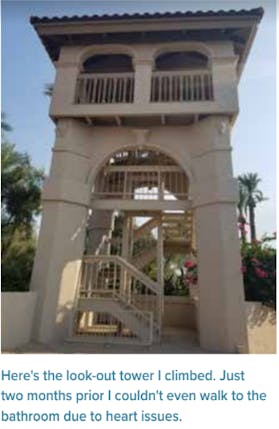
His response was a bit loony. “If you’re feeling better, that just means we need to increase your medications. That’s the way these work. That’s why I want you to increase the dosage, and…” As the cardiologist rattled on, I looked at my brother. This was going exactly the way I had predicted the appointment would go. When this cardiologist had come to visit me in the second hospital, I had an uneasy feeling about him. So, for this visit I was very glad my brother was with me to see and hear the doctor for himself. My gut feelings were confirmed.
When the doctor left the room to give us a chance to decide which procedure to move forward with, my brother said, “You’re right. He doesn’t care about you. He just wants to do more procedures so he can make more money.”
It Takes a Network of People
We left his office that day saying we’d need to think about it and research our options. I went to my support team at Envita Medical Centers, told them my story, and asked if they knew of any natural-minded cardiologists in the area that would be willing to get me off of the drugs. Soon, they referred me to an interventional cardiologist at Valley Heart Associates in Chandler, Arizona, Dr. Ghassan Dalloul. At my first meeting with him I explained my situation, how the cause of my VT had likely been discovered, how I was feeling much better and how I didn’t want to be on drugs and have an ICD for the rest of my life if it was unnecessary. He was willing to help me!
I’ve learned that cardiologists typically work in teams -- one is the general cardiologist who works with the physical aspects of the heart, and the other is the electrocardiologist (also called a cardiac electrophysiologist) who works with the electrical functioning of the heart.
Dr. Dalloul said he was willing to work with the electrocardiologist I had had in the hospital, but would prefer I work with Dr. Huy Phan at Valley Heart Rhythm Specialists (also in Chandler, Arizona). I agreed to see Dr. Phan, and what a blessing! He concurred that, due to my unique situation, it would be best if I could get off the heart medications. And… he said that if my heart truly was recovered from the VT, he would be willing to take out the ICD. (He could do this because it had only been in there less than three months so scar tissue would not have fused the leads to the heart securely yet.) But… my heart would have to pass some important tests (after the heart meds were out of my system) to prove that I didn’t really need the ICD.
The Heart Tests
There was a special test to see if my heart had been damaged by the low doses of the chemo drug, Doxorubicin, I had received. Result: no issues.
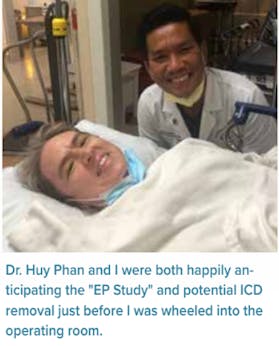
My ejection fraction had returned to 60% (normal)! And after the 30-day heart-rhythm history from my ICD was analyzed, I was cleared for the final test that would be done in the operating room (an electrophysiology [EP] study)… if I passed that test, the ICD and its leads that were screwed into the heart itself, would be removed. If I didn’t pass the test, the ICD would remain. August 31, 2021 was the day to find out.
Although this was a surgical operation, I wasn’t sedated so much as to not be responsive. I remember it all! The “EP Study” test involved using electrical stimulation of the heart to purposely try to get the heart to go into ventricular tachycardia. It was the most bizarre feeling to have my heart manipulated to be pounding one minute and racing the next. Dr. Phan tried every which-a-way to get my heart to “mess up”, but it did not. Yay! So, he removed the ICD right then and there. He removed not just the device itself but the leads that had been screwed into my heart. Praise the Lord! I have had no issues with my heart since and am so grateful to God that He put me in touch with just the right cardiologist to put me back to “normal”.
I have been doing quite well ever since with no heart issues. I can now walk for miles on the farmland surrounding my home here in the foothills of Mt. Hood without a problem. I continue to take a daily dose of Dr. Christopher’s Hawthorn Berry Heart Syrup (NS1643) as I did immediately after the VT attack. Others with heart issues told me how it sincerely helped their hearts heal, and I believe it may have contributed to my quick recovery.
What I Learned
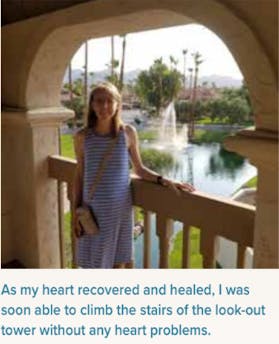
Although I’m thankful for all the technology and treatments that were available to keep me going, so I could have another chance at life, I now have a new perspective. Through this experience, I’ve seen that once the body is out-of-whack and needs unnatural interventions, those very interventions can lead to real trouble.
Now that God has granted me the opportunity to rebuild a healthy body, I’m making extra efforts to discover the real truth about what makes the body function properly as He designed it. I thought I knew a few things… and yes, I believe that I went into this “storm” in better health than many others and that’s why my body has been as resilient as it has. But, there’s more to learn, and by God’s grace He will lead me to that truth, so I can take action.
Most researchers study disease, and there is a place for that. But, it also makes sense to study healthy bodies, discover why they don’t succumb to disease, and try to emulate that. Our bodies were designed quite miraculously to heal themselves. When given exactly what they need, abundant health is the result.
This is video #3 in a series of 4. In it, Susan Booth shares details about her struggle with a Ventricular Tachycardia attack during her cancer treatment in 2021.